

The Estate That Moved Three Times: Inside Meru’s Forgotten Nubian Community
A neighbourhood relocated three times over five decades — and still waiting to be seen.
Drive into Mjini Estate in Meru County and something strikes you almost immediately. There is a stillness here — not the stillness of a place that has given up, but of a people who have learned, over generations, how to endure. The residents greet each other by name. Children dart between narrow pathways. Elders sit in doorways, watching the world move around them. This is a community bound by a common ancestry, a common faith, and a common frustration.

Most of the residents of Mjini Estate are Nubian Muslims. Their story in Kenya didn't begin here — it began nearly 140 years ago, on the banks of the Nile, in what is now South Sudan.
Soldiers of an Empire That Didn't Claim Them
In the late 1880s, Sudanese soldiers began to be absorbed into the British Army. By the time British East Africa was taking shape at the turn of the twentieth century, these soldiers — many of them Nubian — had become essential to the colonial project. They served under the King's African Rifles, occasionally seeing combat, but more often carrying the weight of empire on their backs: food, guns, tents, ammunition.

By the end of the First World War, more than 500,000 Africans had served in the East Africa Campaign. The vast majority were not fighters but porters — men enrolled in what the British called the Military Labour Bureau, later renamed the Carrier Corps.
Of those, an estimated 95,000 lost their lives. That is roughly one in four of every man conscripted into that brutal logistical machine.
By the close of the Second World War, many of these Sudanese soldiers — predominantly Nubian — had made their way to Kenya. The British Colonial Government set aside nearly 4,000 acres of land across the country to resettle members of the Carrier Corps. In Meru, that resettlement took place near what is now the town's main mosque.
"They were settled near Jamia mosque," recalls Mohammed Salim, a former resident of Mjini. "The town grew — and they were eventually relocated."
The First Uprooting
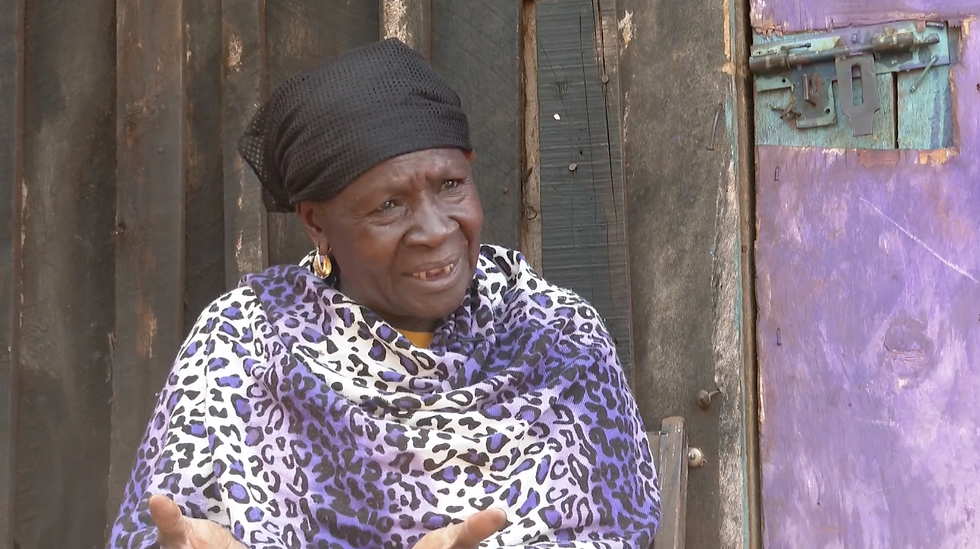
Asha Kajuju's great-grandparents were among those original settlers.
She remembers the stories passed down to her about those early years — small plots of land, a tight community, life built from almost nothing.
"It was just plots… it was just us, wenyeji tu,(only the locals)" she says.
But as Meru town began to grow, the community could no longer remain in the heart of it. The colonial government relocated them to a new site less than a kilometre from town — and this is where Mjini Estate was born.
The problem was, the land was never officially theirs. No title deeds were issued. With no legal claim to the ground beneath their feet, permanent construction was out of the question. Mud huts and tin shacks became the architecture of their lives.
"We would rent the houses for 25 shillings… then 30," Asha recalls.
The estate became known informally as the Nubian Village — though it was never purely Nubian. Arabs, Asians, and other Muslims settled alongside them, drawn together by faith, by proximity, and by a shared sense of existing on the margins.
"Life was hard because we were in town — no land," says Mohammed Ahmed, a current resident whose great-grandfather helped establish the estate more than 70 years ago. "They just allocated. Survival was hard. Not many are learned."
Relocated Again — And Again
The 10 acres allocated for the Nubian Village would not remain intact for long. After roughly a decade, the community faced a second displacement. The Kenya Medical Training College in Meru needed to expand its residential facilities for trainee medics. The land adjacent to the college was earmarked for development. Around 100 housing units were demolished.
Residents were pushed further down.
"We started in town… then Mjini… then now at Kisumu Ndogo," says Asha, tracing the arc of her community's life with quiet resignation. The land that remained was smaller. The plots were cramped. And still, no title deeds. "Plots ndogo ndogo… hawana mashamba," says Mohammed Salim — small plots, no farmland.
Young people grew up, married within the community because there was nowhere else to go, and built on whatever scraps of space remained. Generation after generation, in the same mud walls their grandparents had first raised.
Salama: Where the Old Mjini Lives On
At the far end of the estate lies a stretch of land called Salama. It is home to fewer than 50 households — the people who were moved here when the KMTC expanded. They are, in many ways, the last keepers of the original Mjini.

The name Salama — meaning "peace" in Swahili — has its own story. When one woman was relocated here, she looked around at the relative quiet and declared the place peaceful. The name stuck.
"When she moved here, she said this place was peaceful — thus named Salama," Mohammed Ahmed explains.
The peace, however, has always been hard-won. Mohammed Ahmed is among those whose family has been part of Mjini from the very beginning. He knows, better than most, what that history has cost. "Many here live on less than a dollar a day," says Adam Baaya, another longtime resident. "Ni mtaa ya wachochole — no incomes, no land."
A Community Left Behind
The roots of Mjini's stagnation run deep. When the Nubian soldiers and their families were first resettled here, they were considered foreigners — and the colonial government treated them accordingly. Many were barred from attending formal schools. Without education, they couldn't access meaningful employment. Without employment, they couldn't build wealth. Without wealth, they couldn't escape.
Compounding matters was the long struggle for identity documents. Without national identity cards, residents couldn't participate fully in Kenyan civic life — couldn't vote, couldn't apply for government jobs, couldn't access basic services. It was a bureaucratic trap with no obvious exit.
"Hali yetu ni dhaifu," says Asha Kajuju — our situation is weak. "We need to live better lives. We don't even get the money from the government meant for the elderly." The physical state of the estate reflects this neglect with painful clarity. Many houses are still made of wood or mud — the same materials used when the estate was first established. The roads have never been tarmacked, despite years of appeals from residents. When the rains come, the estate floods and the dirt paths turn to mud.
"When it rains here, it's terrible," says Mohammed Ahmed, pointing to a stretch of road partially patched by a well-wisher. "This was made by a well-wisher."
The sense of abandonment runs beyond infrastructure. Residents say they feel marginalised because of both their heritage and their religion. Mjini was built as a Muslim community — one that organised around the mosque, where children attended Madrassa classes together, and where shared faith was the social glue. "Muslims in Kenya have been marginalised," says Mohammed Salim plainly. "We have been neglected — we are not treated equally like the rest," echoes another resident.
Waiting for a Title Deed
In 1997 — more than five decades after the first Nubians settled in Meru — the neighbourhood finally received allotment letters for its land. Progress came slowly after that. In 2013, the first 25 residents received their title deeds. In 2018, a further 75 housing units were formalised. But a large portion of the population is still waiting — still living on land they have occupied for over 70 years without legal recognition.
"How would you feel, if after all these years you are yet to get titles for your land?" asks Mohammed Salim. It is not a rhetorical question. It is the question that has defined life in Mjini for three generations.
"We don't have equal rights among our peers," says Mohammed Ahmed. "We are a minority. We don't even have a leader representing us."
The numbers tell their own story.
Saidi Mureithi, a resident, estimates there are over 10,000 Muslims in Meru. "We have been neglected," he says. "Yet we are here."
A New Generation, A Familiar Resolve
Mjini Estate is changing — slowly.
A few high-rise buildings have appeared on the skyline in recent years. The community, once exclusively Nubian, has become more mixed through decades of intermarriage and the gradual arrival of outsiders. "Those who have built here are visitors — we intermarried and now outsiders are also among us," says one resident. "We are mixed."
But beneath the change, the community remains tight-knit. The younger residents — those who grew up in the shadow of their grandparents' stories — speak with a determination that feels earned rather than inherited. They point to what Mjini has going for it: proximity to town, a nearby hospital, the beginnings of tarmac roads on the edges of the estate.
"We are close to town. We have tarmac. We have a hospital which will benefit us," says one younger resident, counting the blessings carefully, the way people do when blessings have been scarce. The residents are also waiting for a promised slum upgrade — improved water supply, better roads, decent housing.
"We are waiting for slum upgrade," says Mohammed Salim. "They need clean water, better roads."
What the people of Mjini want is not extraordinary. They want what every Kenyan community deserves: land rights, infrastructure, education, representation. They want to be seen — not as a forgotten colonial footnote, but as citizens with a full claim on the nation their forebears helped, at enormous cost, to build.
They are still waiting. But in Mjini, waiting has never meant giving up.
Mjini Estate is located in Meru County, Kenya. This piece is based on reporting from my show 'Area Code' and can be view on this link.


Hello, this is very interesting and an amazing read, thank you for your efforts
Very informative read!